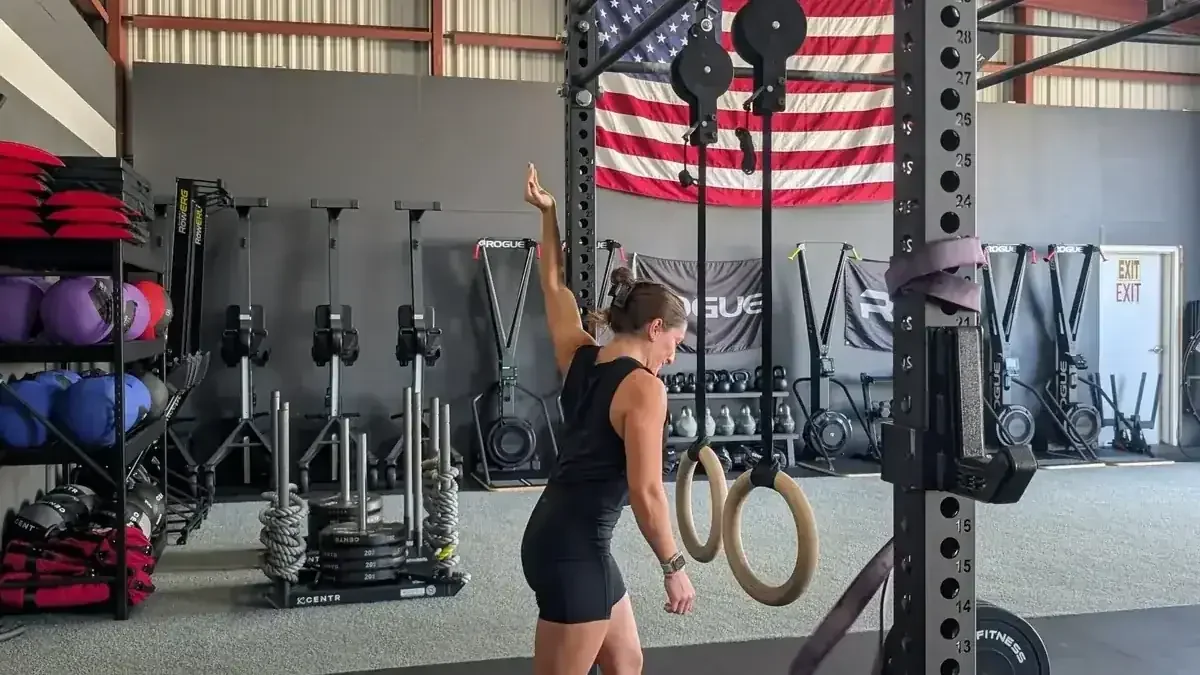
What gymnastics physical therapy should actually involve
Gymnastics physical therapy is physical therapy built around what a gymnast’s body actually does, which means carrying body weight through the hands, holding positions far outside normal range, and training on growth plates that are still open. It should include watching the skill that hurts, and it should send your gymnast home knowing what they can still do this week.

Most physical therapy is built for people who walk, lift and run
A gymnast is doing none of those three things in the moment the injury happens, because they are upside down, or holding their whole body weight on two hands, or landing from height onto a surface that gives very little. A plan written around walking and running never reaches any of that.
That gap is usually what sends a parent looking for an article like this one. Your gymnast has been told to rest, the resting does help while it lasts, and nobody has explained what is supposed to happen afterwards.
Why does ordinary physical therapy struggle with gymnasts?
There are four reasons for that, and every one of them turns up in the treatment room long before it ever turns up on a scan.
The hands carry the body weight. In most sports the wrist holds a racket or grips a bar for a second at a time, while in gymnastics it becomes a weight-bearing joint in the handstand, in the round-off, in the block off the vault table, and in the rings and pommel horse work on the men’s side. Wrist pain is common enough in this sport that a 2020 review in Orthopedic Clinics of North America gives the overuse injury of the wrist growth plate the name of the sport itself, and reports wrist pain in as many as 88 of every 100 gymnasts 1.
The ranges asked of the shoulder and the spine sit far outside normal. A standard shoulder screen asks whether you can lift your arm overhead, while a gymnast has to hold a handstand up there and then press out of it. That is why a gymnast can pass the ordinary screen, collect a clean result and walk back out with the same problem, because nothing in the screen ever reached the position that hurt.
In a growing gymnast the softest link in the chain is bone. Growth plates stay open until the skeleton finishes maturing, and growing bone handles repeated stress less well than adult bone does, which is the point the American Academy of Pediatrics made again in its 2024 clinical report on overuse injury in young athletes 2. With a 30 year old I am usually thinking about tendon, and with a 12 year old I am thinking about the growth plate at the wrist, at the knee and at the heel.
The meet calendar does not move because somebody is sore. A plan that ignores the season tends to get ignored by the family in return, and it probably should be. When there is a meet on the schedule and the wrist hurts on floor, the useful conversation covers which events are still realistic, what gets trained around them, and how we take load off that wrist everywhere else in the week.
Tell me what she cannot do right now and what is on the calendar. I will tell you how I would go about it, and whether I am the right person for it.
Talk to Chris for freeWhat I see most often in gymnasts
Wrists come up most of all, because anything that puts a gymnast’s weight onto the hands loads the wrist near the end of its range, and a wrist that hurts in a handstand will usually hurt in every other skill that passes through one.
Low backs come next, from the repeated arching in walkovers, back handsprings, bar work and high bar. A 2022 review in the British Journal of Sports Medicine pooled 80 studies and found that 42 of every 100 adolescent athletes had reported low back pain in the previous year 3. The most common finding on their imaging was spondylolysis, which is a stress injury to a small piece of bone at the back of a vertebra.
After those two it tends to be shoulders on bars and rings, along with knee and heel pain in a child who is growing quickly, where the sore spot sits right on a growth plate rather than in the muscle around it.
What should a gymnastics physical therapy visit look like?
The hour belongs to one person and it is the same person on every visit, so nobody hands your gymnast a sheet of exercises and then walks off to start somebody else in the next room.
I ask to see the skill that hurts, so if that skill is a back handspring then I want to watch a back handspring, or the closest version of it that can be done today without making anything worse. Pain that only turns up in one position is very hard to find from a treatment table, and gymnastics is full of positions that no table can copy.
The plan then leaves with two lists on it, and the second one usually matters to a family more than they expect: what to hold off on for now, and what can carry on this week. A gymnast who only ever hears the second kind of list will generally stop telling anybody when something hurts.
Parents are welcome to sit in and most of them do, although if you would rather wait outside and let your gymnast have the hour to themselves, that works just as well and you will get the same explanation at the end of it.
Four questions worth asking before you book
- Have you treated gymnasts before? The sport carries its own injuries and its own vocabulary, so ask for specifics and listen for whether the answer talks about events and skills rather than muscles alone.
- Will you watch the skill that hurts? If the assessment never leaves the treatment table then the position that provokes the pain never gets tested, and that position is the entire reason you came in.
- What will my gymnast be allowed to keep doing? Any honest answer has to depend on the examination, so what you are really listening for is whether the question gets taken seriously at all.
- Will you talk to the coach? A coach controls far more hours of the week than I ever will, so a plan that the coach has never heard about is a plan that lives in a folder.
How I work with gymnasts
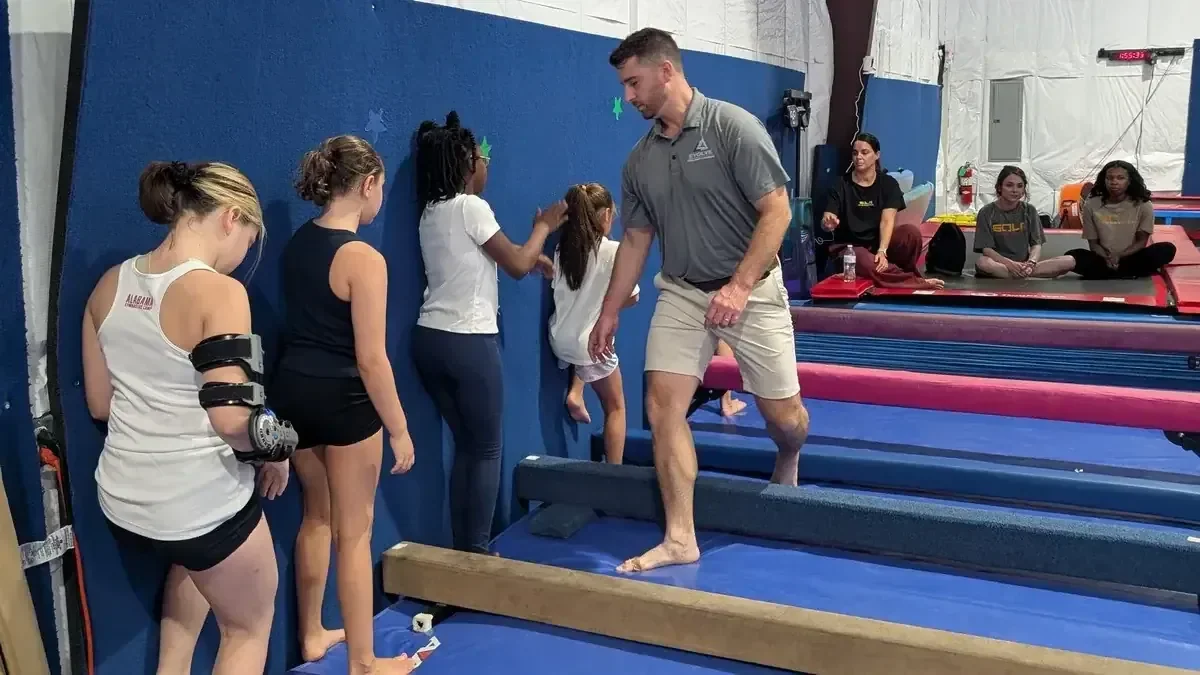
I am Chris West, PT, DPT, and I run Evolve Physical Therapy and Performance in Lafayette, Louisiana, where I see one person at a time for a full hour on every single visit. I am a Fellow of the American Academy of Orthopedic Physical Therapy, which is the highest level of structured orthopedic training physical therapists can receive. I also teach injury-prevention workshops at a gymnastics gym here in town, so I have spent a great many hours watching these skills up close.
With a gymnast that means I watch the tumbling or the swinging before I write anything down, I keep the coach in the loop whenever the family wants me to, and I will tell you how I would go about the problem rather than reading out a timeline that nobody can promise.
There is more detail about how that works on my gymnastics page.
One thing to be clear about. This is general information, written from what I explain in the clinic every week. It is not a diagnosis and it does not replace being assessed by somebody who can watch you move. If something is getting worse, or you have weakness, numbness, or pain that does not change with position, see a clinician rather than an article.
Questions I get asked
Should my gymnast rest until the pain goes away?
Rest will usually quiet the pain down, and it does not change what the wrist or the back will tolerate once training starts again. The more useful plan takes load off whatever is causing the trouble, keeps the training that can carry on without provoking it, and then rebuilds the hard parts deliberately.
What if there is a meet coming up?
Tell me at the first visit, because a meet on the calendar changes what I prioritize, which events we protect and what we leave alone for the moment. I would far rather build the plan around a season that already exists than pretend that the season is not there.
Is wrist pain just part of gymnastics?
It is common in the sport, which is not at all the same thing as normal. Wrist pain that keeps coming back in a young gymnast deserves a proper look, because the growth plate at the wrist is one of the places where repeated loading can leave a lasting mark.
Will you talk to the coach?
Yes, whenever you want me to. A coach sees your gymnast for far more hours each week than I ever will, so a plan that the two of us have agreed on is the plan that actually gets followed in the gym, and I will always tell you exactly what I am asking the coach for.
Sources
- Mauck B, et al. Gymnast’s Wrist (Distal Radial Physeal Stress Syndrome). Orthopedic Clinics of North America, 2020. pubmed.ncbi.nlm.nih.gov/32950218/
- Overuse Injuries, Overtraining, and Burnout in Young Athletes. Clinical report, American Academy of Pediatrics. Pediatrics, 2024. pubmed.ncbi.nlm.nih.gov/38247370/
- Wall J, et al. Incidence, prevalence and risk factors for low back pain in adolescent athletes: a systematic review and meta-analysis. British Journal of Sports Medicine, 2022. pubmed.ncbi.nlm.nih.gov/36150752/